
West Springfield Past Households by Era
There is no verified public former-resident index for West Springfield. The reliable route is a dated trail assembled from separate custodians. Begin with the parcel and recorded land reference, then select the source that can cover the period in question. A deed can reach farther back than a directory, while a directory can be better evidence of occupancy. A permit, newspaper, vital record, or probate file may explain a transition, but none should be made to do the work of every other source.
| Historical source | Verified coverage | Where to use it | Address-history value |
|---|---|---|---|
| Hampden Recorded Land | 1636-present custody; post-1948 fully indexed; earlier scanned index | Hampden County Registry of Deeds | Deeds, mortgages, liens, plans, parties, and legal descriptions |
| Hampden Registered Land | 1899-present online range stated by Registry | Registry registered-land route | Document numbers, certificates, plans, encumbrances, and title material |
| West Springfield directories | 1860-present local holding | Bertera History Room | Address-to-occupant and occupation clues by year |
| Town Reports | 1860-1983 | Bertera History Room | Roads, public works, offices, and municipal changes |
| Federal census | Latest generally available census is 1950 | National Archives or library databases | Household on an enumeration date, not a continuous address record |
| Historic probate | Hampden index 1812-1986, with narrower book and file ranges | FamilySearch, American Ancestors, or Court Archives | Estate roles, residence wording, heirs, wills, and transfer leads |
For a recent title question, start with a current parcel reference and the Registry. For a household question from an earlier decade, pair the Registry result with directories and the census. Use a source's stated coverage, not a guessed online date, when writing down a negative result.
West Springfield's 1948 Deed Search Fork
The year 1948 is a practical dividing line for past-resident research. The Hampden Registry instructions document full post-January 1, 1948 indexing by name, address, book and page, year and instrument number, and entry date. For earlier records, use the scanned Grantor/Grantee index, choose the relevant party type, add a last name and optional first name or year range, read the scanned index book, and extract the book and page. West Springfield's municipality code is W S.
The Registry's recording-fee page also distinguishes access from recording. Ordinary online document copies are described as free, while certified copies are $1 per page. Recording fees vary by document type and should be verified before payment. A mailed offer for an expensive certified deed copy is not the same as the official copy route.
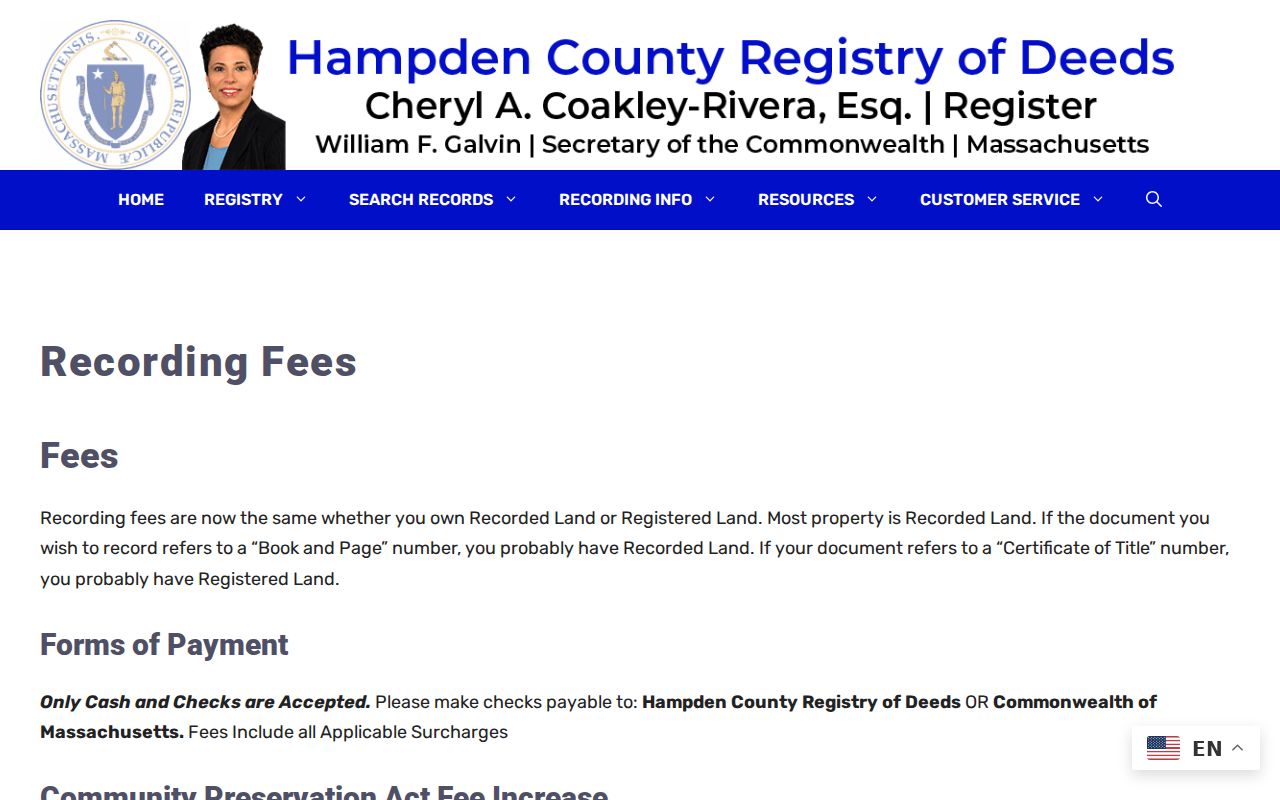
The fee information helps document a record trail without treating the assessment view or a commercial mailing as a title source. For a legal conclusion, compare the deed image, plan references, and any later encumbrance material.
Trace Past Residents Through Hampden Deeds
Start the backward trail with West Springfield AxisGIS or the municipal GIS, then move to the Hampden County Registry of Deeds. The assessment card can provide a current tax-record snapshot, parcel identifier, map/block/lot, and Registry book/page reference. It does not settle title. The recorded deed should supply the instrument, parties, date, and legal description. Read mortgages, releases, assignments, plans, municipal liens, and probate transfers as related records rather than assuming a last-sale field contains every transition.
- Locate the current parcel in the West Springfield AxisGIS Property Viewer and note the PIN, the local parcel identifier, the situs address or physical parcel location, map/block/lot, registry reference, and search date.
- Open the current deed or the latest title reference in the Hampden Registry. Record the person receiving title, called the grantee, the person transferring it, called the grantor, the instrument type, entry date, book/page or document number, and plan or lot language.
- Search the seller as an earlier grantee, then repeat the sequence backward. If a deed uses an estate, trust, or executor caption, preserve that role instead of assuming a household relationship.
- Switch to the scanned Grantor/Grantee index when the 1948 index boundary is reached. Search spelling variants, initials, and the documented
W Smunicipality code. - Pause when a subdivision, merger, condominium conversion, right of way, or changed legal description appears. Compare the plan and parcel identifiers before continuing the chain.
- Grantor / grantee
- The grantor transfers an interest in a recorded instrument. The grantee receives that interest. Those roles do not by themselves identify every person who lived at the property.
- Chain of title
- A dated sequence of recorded transfers and related documents connected by parties, document identifiers, and legal descriptions.
- Legal description
- The lot, plan, metes-and-bounds, unit, or other land description used in title records. It often remains useful when a street number changes.
- Registered Land
- A separate title-certificate system that uses document numbers and certificates instead of the ordinary Recorded Land book-and-page path.
The Hampden Registry abbreviation reference should be consulted for document codes rather than expanded from memory.
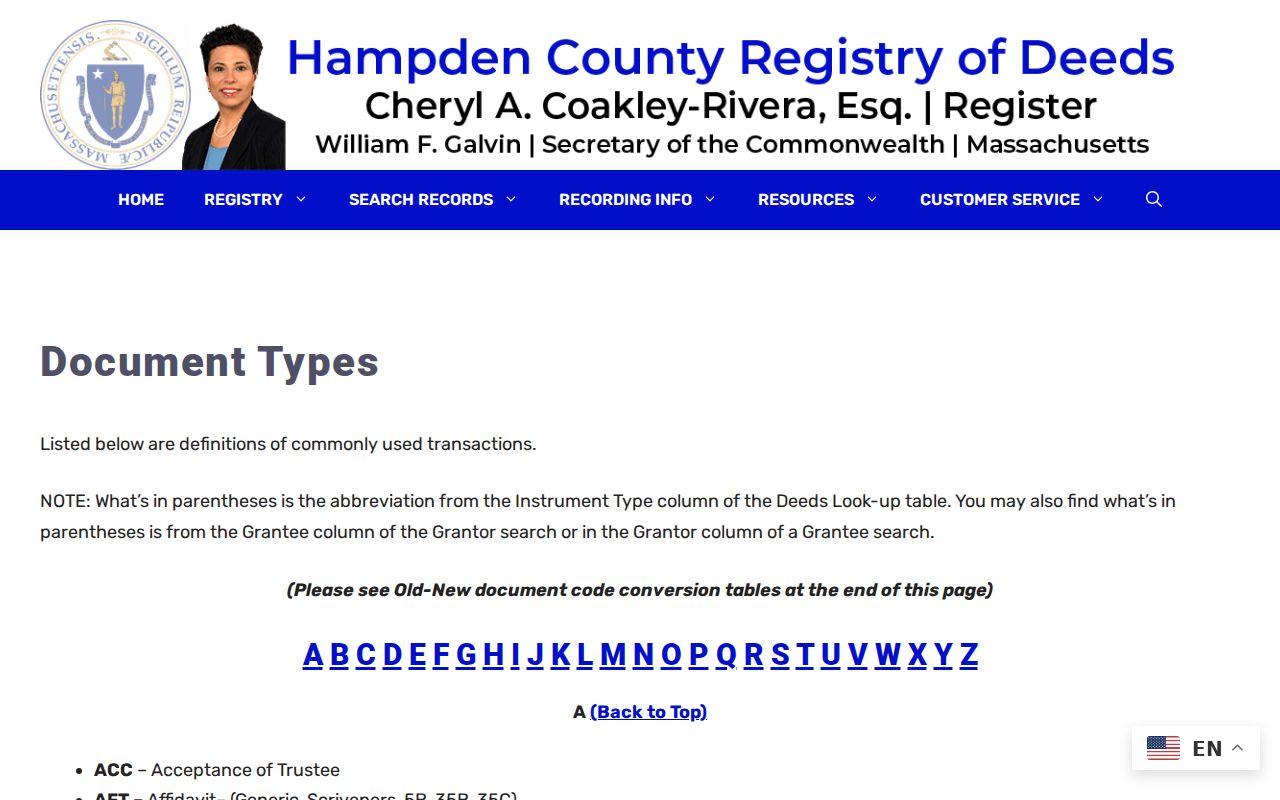
That reference is especially useful when the chain includes easements, assignments, releases, municipal liens, or estate-related instruments that do not resemble an ordinary sale.
West Springfield Past Households in Directories
A deed identifies a transaction party, not necessarily the people living in a home. West Springfield's Bertera History Room holds local directories from 1860 to the present, plus maps, newspaper articles, yearbooks, and Town Reports from 1860-1983. The collection is used in the room during open hours or by appointment. It has a microfilm reader, but says printing and scanning are unavailable, so take notes or ask about permitted photography.
For each entry, record the directory title, year, page, street spelling, name line, any stated occupation or household notation, and the publisher's abbreviation key. A person can appear as an owner, boarder, business occupant, or at an old address. The West Springfield city directory collections provide the fuller catalog and reading context, while the address trail needs only the entries that connect to the property chronology.
Springfield City Library adds regional directories and newspapers, but each volume must be checked for West Springfield coverage. Its newspaper holdings report a September 1946 strike gap. A missing notice from that period should be logged as a coverage limit, not used to declare that an event never happened.
Pair West Springfield Directories With Census Years
Directories and census schedules work best together because they answer different questions. A directory can place a listed person at a street address in its publication year. A federal census describes a household on a particular enumeration date, the date census takers recorded it. The latest federal census generally available under the 72-year rule is 1950. Neither source makes a decade-long occupancy claim by itself.
- Start with a directory entry that has a street number and record the exact publication year and page.
- Check the closest available federal census and retain its enumeration date rather than treating it as the same date as the directory.
- Compare surname variants, initials, age, family relationships, street wording, and adjacent household context before joining the entries.
- Use a later directory, deed, permit, or probate item to test whether the address connection continued or changed.
- Mark an unresolved interval as a gap. Search adjacent numbers and street spellings before suggesting a move or renumbering.
West Springfield's historical context makes this caution important. It separated from Springfield in 1774, received a tract from Westfield in 1802, and retained Town of West Springfield wording after becoming a city in 2000. A catalog heading, street reference, or municipality label should be read with its date.
West Springfield Previous Residents and Probate
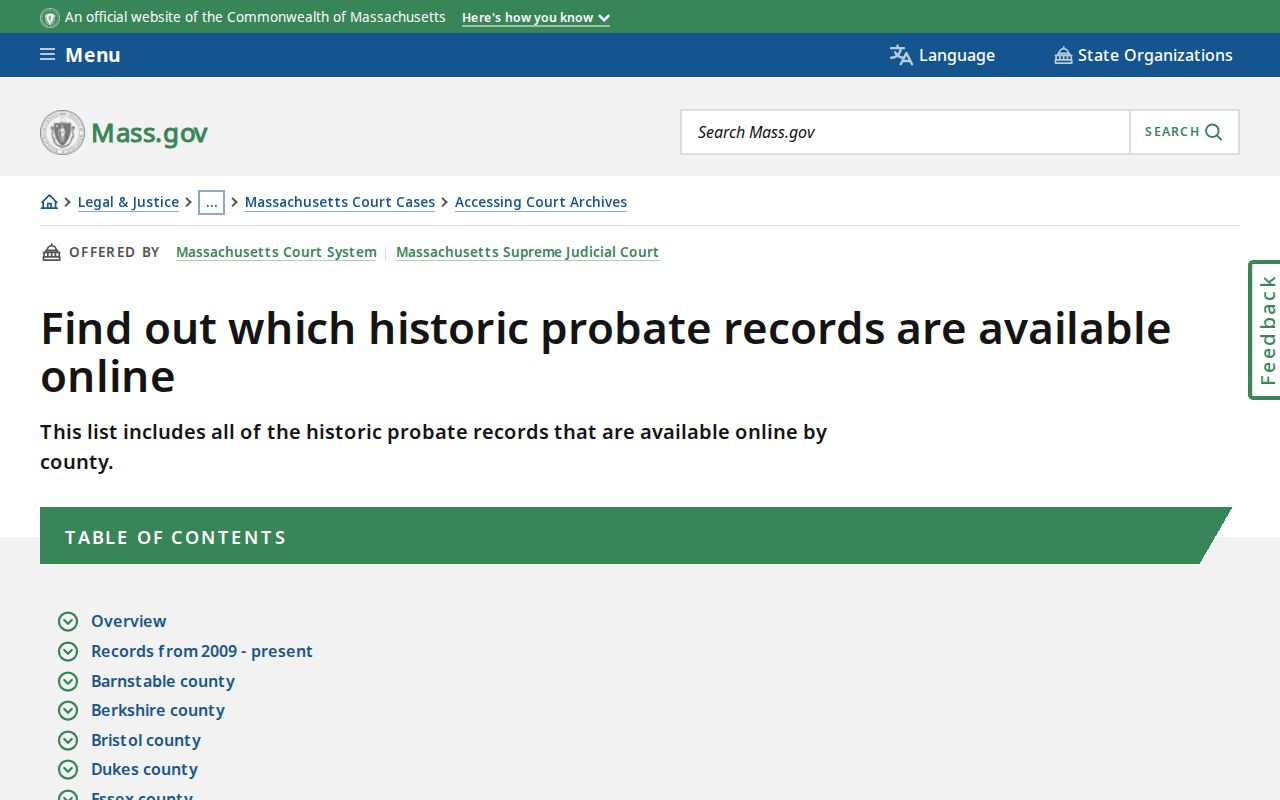
When a deed names an estate, executor, administrator, or trust, the address history may continue through probate. The historic-probate guide identifies Hampden indexes from 1812-1986, docket books from 1858-1916, record books from 1814-1929, and file papers from 1809-1881 through established genealogy and archive routes. Probate can provide an estate role, docket, the court's case identifier, residence wording, will, administration, or a lead to a transfer. It does not automatically identify every family member's address.
The Massachusetts historic-probate guide below documents the available Hampden routes and coverage.
Vital records can corroborate an event or relationship only within their access rules. State Archives has custody for 1841-1935 vital records, while RVRS holds 1936-present records and the Town Clerk handles current municipal copies. Death-record SSN access rules changed on July 1, 2026, so current instructions should be checked at the time of a request.
The Massachusetts Archives vital-record collection provides the historical-custody route captured below.

Use a three-source close when possible: a dated directory or newspaper reference, a probate or vital record where access permits, and a Registry document. The research did not verify a West Springfield-specific funeral-home archive or cemetery index.
West Springfield Historic Address Context
Historic maps can explain why an address looks unfamiliar. The Massachusetts Digital Archives provides a 1795 Plan of West Springfield and two 1831 J. Lathrop plans. Align road lines, river geography, bridges, settlement names, and the record's municipal label with the current GIS. The comparison can help explain a changed street description or a Springfield reference. It cannot establish a modern parcel boundary without a recorded plan or survey.
No official West Springfield street-renumbering list, street-renaming index, E911 conversion record, or verified Sanborn map sheet was located in the research. If numbers appear to jump, compare the deed, directory, Town Report, historic plan, and current parcel PIN. Ask the Town Clerk or GIS administrator for a dated addressing record if the discrepancy affects the identity of the property.
Hampden County's administrative government was abolished in 1998, but the state-administered Hampden Registry of Deeds remains the county land-record office. That institutional difference explains why a historical address search may move between municipal GIS, a Springfield Registry office, library collections, and statewide archives.
Document West Springfield Past Address Evidence
A useful address-history worksheet makes uncertainty visible. Record the address exactly as the source prints it, then add the source date and the person's role. A tax-record owner, title party, directory occupant, voter registrant, permit applicant, business officer, or probate heir is not the same label. This role audit prevents a public record from becoming a claim about a current household.
| Keep with each finding | Why it matters |
|---|---|
| Address wording and parcel reference | Shows whether a later address, lot, or plan is the same property. |
| Source, repository, and URL | Lets another researcher return to the record custodian. |
| Year, date, volume, and page | Separates a dated event from an undated assumption. |
| Person and role label | Distinguishes owner, grantor, grantee, occupant, applicant, or estate representative. |
| Book/page, instrument, docket, or map identifier | Creates a repeatable route to the original record. |
| Confidence note and gap | Preserves unresolved spelling, boundary, or coverage questions. |
Keep the records in sequence and cite the primary image when available. A source log is more durable than an unsupported statement that a particular person was a former resident.
Limits on West Springfield Previous Residents Trails
Past-resident research cannot create a complete, present-day person list. A title chain can skip occupancy, a directory can omit a household or use an old address, and a census captures only an enumeration date. The research did not verify an official former-resident database, an address-to-occupant archive, a complete local obituary index, or a current public cemetery index. Write “no record found in this source and year” instead of “no resident.”
Massachusetts Public Records Law, G.L. c.66 §10, concerns existing public records and is subject to exemptions. A narrow request for a specified existing municipal record is appropriate when the custodian is known. It does not require an office to make a new person-level compilation. Protected addresses, protected voter records, sensitive vital fields, and sealed court matters require additional care.
The Hampden Registry access and document guide is the official source for public registry access, document types, atlases, and Register functions.
The Registry is a strong land-record source, but it should be combined with a dated household source before describing someone as part of a house history.
Lawful use. West Springfield house-history research can support family history, estate questions, property research, and personal curiosity. Do not use historical records to stalk, threaten, harass, or intrude on a living person.